For any enthusiast or professional in the world of resin 3D printing, the word hassle conjures a familiar set of scenes: sticky resin bottles, the pungent smell of isopropyl alcohol, the tedious removal of supports, and the exhausting cleanup of the workspace. While traditional resin printing grants us unparalleled precision, it has always bundled this dirty work as part of the price of admission. Consequently, the idea of a truly hassle-free resin printing experience has remained a near-mythical Holy Grail.
However, as technology evolves, a new generation of devices, built around high levels of integration and automation, has emerged to redefine the user experience. We are compelled to ask: have we finally reached a turning point? Today, we will take a deep dive into a prominent example—a resin 3D printer from HeyGears—to examine whether it lives up to the claim of being the first truly hassle-free machine.
The Pain Points of Traditional Resin Printing
To understand what hassle-free means, we must first clearly define the hassle. The conventional resin printing workflow is a chain of manual steps, each one a potential point of failure and a source of frustration.
It begins with model preparation, where manually adding and optimizing supports requires considerable experience; improper settings can lead to print failure or a damaged model. During the print, the user must accurately estimate resin usage, and the tragedy of running out of resin mid-print is a common tale.
After the print finishes, the real battlefield emerges. The user must carefully remove the model, dealing with dripping resin and a vat that needs cleaning. This is followed by washing the model in isopropyl alcohol—a process that not only generates volatile fumes but also leaves you with hazardous waste liquid to handle. Next comes post-curing, where the model needs uniform UV exposure. Finally, supports must be removed and the surface sanded. By the end of this entire process, the initial spark of creative passion is often extinguished by physical exhaustion. A single oversight at any stage can render hours of printing utterly worthless.
A Look Inside the HeyGears’ Hassle-Free’ Solution
The core of the HeyGears 3D printers‘ philosophy is an attempt to reshape this manual, sequential chain into a highly automated, closed-loop experience through the integrated design of its hardware, software, and materials. Its claim to being hassle-free is built on the following pillars:
Pillar 1: Radically Simplified Post-Processing
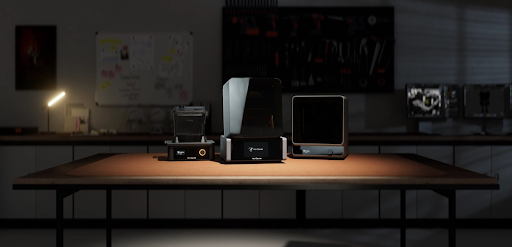
This is one of the most compelling features of a HeyGears device. The trickiest part of the traditional workflow—the cleaning process—is streamlined by an integrated washing station. The user typically just needs to move the entire build platform, model into the station, and the machine handles the rest. The dual-cleaning box design allows users to complete the cleaning process in one box and then direct the cleaning fluid into the other. This design significantly reduces direct contact with liquid resin and isopropyl alcohol (IPA) while ensuring more standardized cleaning results—effectively avoiding problems such as sticky residue or inadequate curing caused by improper manual cleaning. This design provides a direct and effective solution to the core health and safety concerns of resin printing.
Pillar 2: A Closed Printing and Material Ecosystem
Many traditional resin printers are semi-open, leaving the resin vat exposed. HeyGears, however, often employs a more enclosed design paired with its own proprietary resin cartridges. This not only reduces the escape of odours during printing but, more importantly, it enables one-click material changes or simpler refilling, avoiding the drips and spills common when pouring from a bottle. A proprietary material system also ensures a perfect match between printer parameters and resin properties, reducing the risk of print failures from the source—a massive value for rapid prototyping users who demand reliability.
Pillar 3: Intelligent Software and a Closed-Loop Experience
The hassle-free experience extends beyond hardware. The proprietary slicing software Blueprint Studio, developed by HeyGears, is typically deeply optimized for its hardware, with auto-support algorithms designed to minimize the need for manual tweaking. The entire workflow—from uploading a model and slicing, to sending the job and moving it to the wash/cure station—is completed within a unified ecosystem. This closed-loop experience minimizes the uncertainty and learning curve associated with switching between different software and hardware, allowing miniature hobbyists and designers to focus on creation, not calibration.
A Reality Check: The Trade-Offs and Limitations
While we can celebrate this automation, we must also ask a sobering question: Does this mean the experience is absolutely, 100% hassle-free? The answer is likely no. Hassle-free is a relative concept, and it comes with clear trade-offs.
First, a closed ecosystem often means sacrificing choice. Users may be locked into the brand’s proprietary resins, which can be more expensive and limit access to the vast and varied world of third-party materials. For advanced users who love to experiment with different resin properties (e.g., high-toughness, castable, or transparent), this can feel restrictive.
Second, the initial investment is typically higher. A system that integrates washing, curing, and printing is far more technologically complex and costly to manufacture than a standalone printer. Users need to evaluate if the premium paid for this convenience is worth it for their specific needs.
Finally, the machine is not omnipotent. Even with high levels of automation, basic maintenance—such as changing the FEP film or cleaning sensors—is still the user’s responsibility. The system dramatically simplifies daily operations but does not eliminate the need for long-term care.
Conclusion
So, let’s return to the original question: is this the first truly hassle-free resin 3D printer on the market? Perhaps a more accurate assessment is this: it represents a profound leap forward on the road toward a hassle-free future and is one of the closest solutions to that ideal available today.
Through its systematic and integrated design, it successfully transforms resin printing from a craft that demands significant knowledge and physical effort into a streamlined process that feels closer to a modern home appliance. For users who prioritize stability, efficiency, and safety, and who are willing to pay a premium for convenience—such as rapid prototyping teams, professional designers, and miniature creators with a strong need for simplified operation—a product like this from HeyGears genuinely delivers an unprecedented, near-hassle-free experience.
It may not yet be the perfect machine for every single user, but it has unquestionably set a new benchmark for the entire industry. It points toward a clear future where true innovation lies not in the numbers game of ever-higher resolution, but in making technology more humane and seamlessly integrated into our creative lives. For anyone who has been drawn to the potential of resin printing but daunted by its complexities, this is a very exciting development indeed.